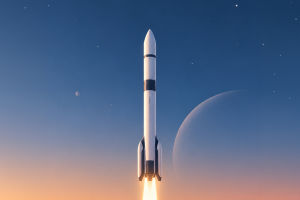
A rocket begins its journey as an enormous vehicle packed with propellant, engines, and equipment. Yet the spacecraft that eventually reaches orbit is often much smaller. Along the way, entire sections separate and fall away. These dramatic events are not accidents but essential parts of the flight plan.
The reason is simple: every extra kilogram requires energy to accelerate. Once a rocket stage has burned its propellant, its empty tanks and engines become unnecessary weight. Staging removes that burden, allowing the remaining vehicle to continue accelerating toward its destination.
Why Rocket Mass Matters
A chemical rocket must carry fuel and an oxidizer, along with engines, tanks, structural components, and its payload. This makes propellant a large fraction of its initial mass. As the engines burn propellant, the rocket becomes lighter, allowing the same force to produce greater acceleration.
However, empty tanks and spent engines still have mass. Carrying them farther requires additional propellant, reducing the vehicle's efficiency.
This matters because reaching low Earth orbit requires tremendous speed. A spacecraft typically travels at about 7.8 kilometers per second in orbit, while the launch vehicle requires an even greater total velocity change to account for gravity and other ascent losses.
Why Single-Stage Rockets Are Challenging
A single-stage-to-orbit rocket would reach orbit without discarding any major propulsion stage. The concept is physically possible, but achieving a useful payload capacity with conventional chemical engines is extremely difficult.
Such a vehicle must retain its tanks, engines, and supporting structures throughout the ascent. As propellant burns, that hardware becomes an increasing burden.
Engineers must therefore achieve an exceptionally favorable combination of lightweight construction, efficient propulsion, and sufficient force.
The experimental McDonnell Douglas DC-X demonstrated vertical takeoffs and landings during the 1990s, but it was a suborbital technology demonstrator, not an orbital vehicle. No single-stage-to-orbit rocket has yet completed an orbital mission.
How Stage Separation Improves Performance
Multistage rockets divide their propulsion systems into sections that operate during different portions of flight. Once a stage finishes its main burn, it separates, removing tanks, engines, and structural equipment that the remaining vehicle no longer needs.
The Saturn V demonstrated this approach during the Apollo program. Its first stage, the S-IC, used five powerful F-1 engines during the opening ascent. After approximately two and a half minutes, the engines shut down, and the stage separated before falling into the Atlantic Ocean.
The second stage, called S-II, then continued accelerating the lighter vehicle.
Separation does not itself create a major speed boost. Instead, it reduces the mass that subsequent engines must accelerate, improving overall performance.
What the Rocket Equation Reveals
The Tsiolkovsky rocket equation explains why reducing unnecessary mass matters. It relates a rocket's ideal velocity change to its effective exhaust velocity and the ratio between its initial and final mass.
The simplified equation is Δv = ve × ln(m0/mf), where Δv represents velocity change, ve is effective exhaust velocity, and m0 and mf are initial and final mass.
Because the relationship is logarithmic, achieving additional velocity change becomes increasingly demanding.
Staging improves performance by removing structural mass between propulsion phases. Each stage contributes its own velocity change, allowing the vehicle to achieve a greater combined result.
Actual launches must also account for gravity, aerodynamic drag, and steering losses.
How Rockets Separate Safely
Stage separation requires precise timing and carefully designed mechanisms. Depending on the vehicle, engineers use mechanical releases, springs, pneumatic devices, or pyrotechnic systems to disconnect sections and move them apart.
Many rockets use cold staging, where one stage separates before the next engine ignites. Falcon 9 follows this approach during its normal ascent.
Hot staging works differently. The upper stage begins firing while the stages remain connected or closely coupled, reducing the interruption in propulsion. SpaceX's Starship system uses this technique with an interstage structure designed to handle the exhaust.
Both methods require careful engineering to prevent collisions, structural damage, and ignition problems.
Staging Beyond Earth's Atmosphere
Staging is useful for missions beyond the initial launch. During the Apollo mission, the lunar module used separate descent and ascent stages. After landing, astronauts departed in the ascent stage, leaving the descent stage and landing legs on the lunar surface.
The James Webb Space Telescope also benefited from a multistage launch vehicle. Its Ariane 5 rocket used solid boosters and an upper stage to send the observatory toward its destination.
Modern reusable rockets add another possibility. Falcon 9's first stage can separate and return for landing rather than being discarded.
Recovery requires extra equipment and propellant, but it allows expensive hardware to fly again. The fundamental advantage of staging remains unchanged: unnecessary mass no longer accompanies the payload.
Rocket staging solves one of spaceflight's greatest challenges: accelerating a heavy vehicle while carrying as little unnecessary mass as possible. By separating spent sections, rockets improve their performance and make demanding missions more practical.
The process introduces mechanical complexity, but its benefits have shaped everything from the Saturn V to modern reusable launch systems.
When a rocket sheds a stage, it is not simply throwing equipment away. It is making a carefully calculated trade that helps the remaining spacecraft travel farther and faster.